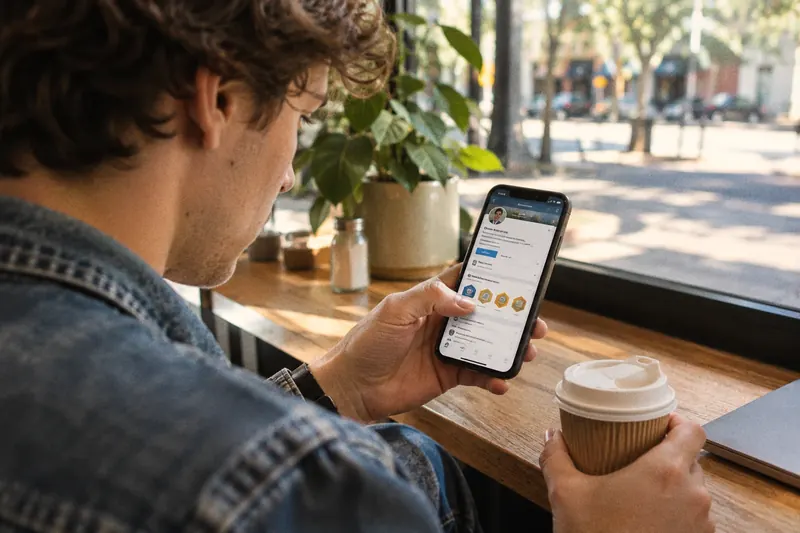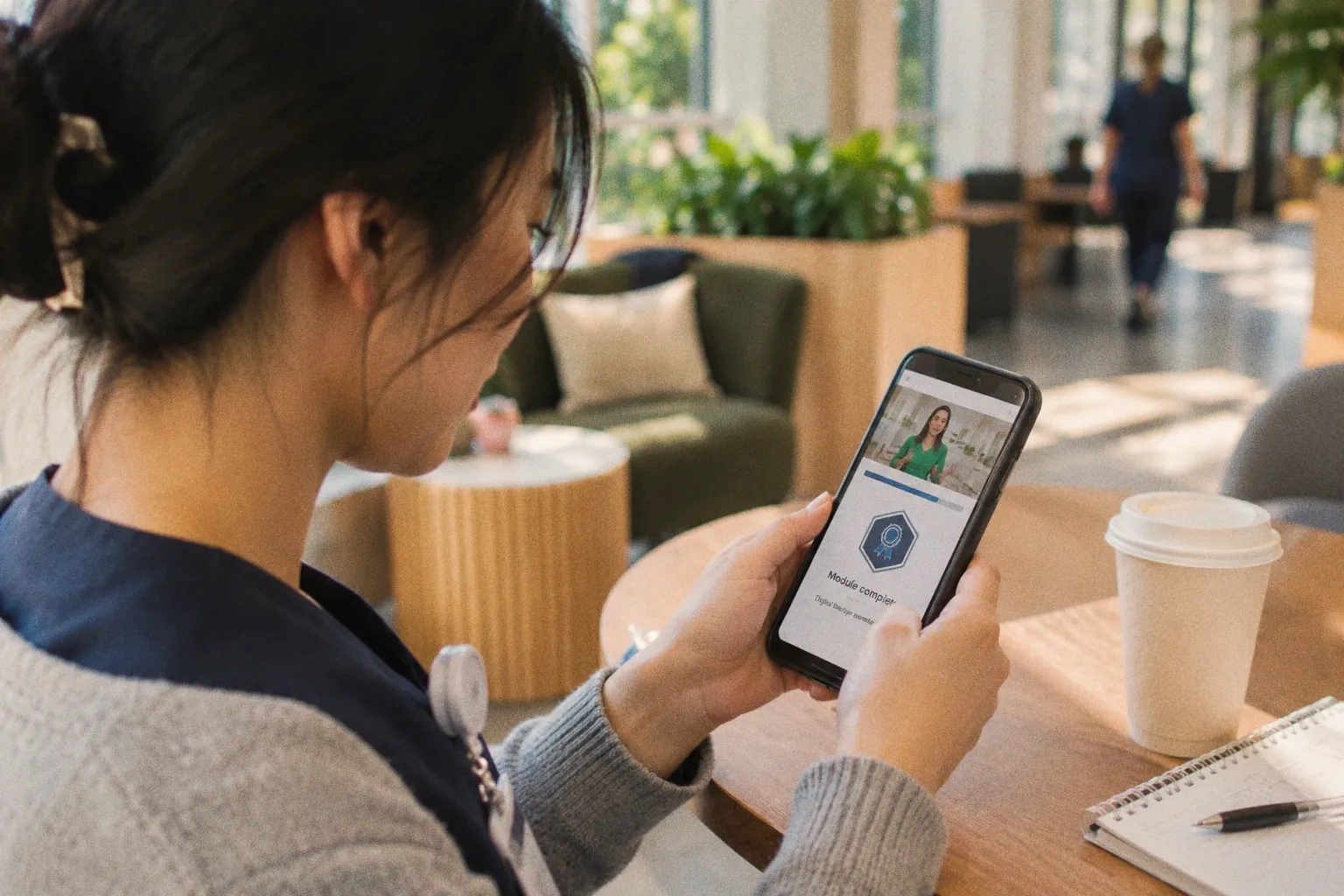
Recent digital badge examples include Microsoft's Pro Badge for GitHub Copilot, earned from tracked product use with no exam; East Texas A&M's engineering badges, which need an A in every linked course plus a professional activity; and San Antonio College's research badge, awarded by trained faculty. What a badge proves depends entirely on what it requires.
Key takeaways
- Microsoft's Pro Badge for GitHub Copilot, generally available from 28 October 2026, is awarded when a learner's everyday Copilot use reaches the 'proficient' level, with no exam or lab.
- On 19 November 2026 Pearson said Credly had issued 150 million digital credentials, 50 million of them in under two years.
- East Texas A&M's new engineering badges (28 September 2026) need an A in each designated course and an approved activity such as research, a conference or a workshop.
- San Antonio College's Undergraduate Research Skills Badge (9 October 2026) is awarded by trained faculty when students demonstrate four research competencies.
- Employer studies are small but consistent: employers value badges when they can see who issued them and what was required to earn them.
The most talked-about digital badge of the past month has no exam. On 28 October 2026, Microsoft made its Pro Badge for GitHub Copilot generally available: developers opt in, and the badge is awarded when their everyday use of the tool reaches the “proficient” level (Davis, 2026; Sharwood, 2026). In the same few weeks, two US universities launched badges that ask for much more traditional proof: an A in every linked course, or research skills assessed by trained faculty. And Credly passed 150 million credentials issued. Put side by side, these examples show the one thing every badge designer has to decide: what the learner must do to earn it.
Three new badges, three kinds of proof
Microsoft: proof from use. The Pro Badge works alongside Microsoft’s certifications rather than replacing them. Microsoft’s proficiency framework has five levels, from beginner to expert, and “To earn a Pro Badge, users must reach the proficient level”, The Register reports. Microsoft describes it as “a current, verified signal of what you can do, at no cost and without a separate exam or study guide” (Sharwood, 2026). The level is worked out from signals across GitHub.com, the code editor, the command line and mobile. I Programmer notes that “Participation is entirely optional and results remain private by default”, and that proficient means “consistent hands-on usage across multiple repositories and extended periods” (Gee, 2026). The exam-based GitHub Copilot certification still exists, at 99 USD (Davis, 2026).
East Texas A&M: proof from grades plus practice. On 28 September 2026, the university’s Department of Engineering and Technology launched badges in construction, electrical and industrial engineering, technology management, and AI management for graduate students. To earn one, a student needs an A in each designated course and must “participate in an approved discipline-related activity, such as research, a conference, seminar or workshop”. The department head, Burchan Aydin, put it plainly: “Students must earn A’s in all designated courses, but strong grades alone are not enough” (East Texas A&M, 2026).
San Antonio College: proof judged by trained assessors. On 9 October 2026, the college announced an Undergraduate Research Skills Badge built on four competencies: framing, proposing, realising and disseminating research. Faculty complete specialised training first, after which they are “qualified to award the badge to students who successfully demonstrate the required research competencies”. Seven faculty form the first cohort, and 15 from St. Philip’s College join the second (San Antonio College, 2026).
digital badges awarded by one university, University of Phoenix, by March 2026
proficiency levels in Microsoft's framework; the Pro Badge needs the third, proficient
The scale behind it
Badges are no longer a niche. On 19 November 2026, Pearson said its Credly platform had issued 150 million digital credentials, the most recent 50 million in under two years (Pearson, 2026). Single institutions now issue them at volume too. University of Phoenix announced its millionth badge in March, from more than 170 badge offerings, and describes them as “Grounded in assessed skills—not participation” (University of Phoenix, 2026).
That volume is the problem as much as the progress. When a recruiter sees a badge, the image tells them almost nothing. The badges above all look alike on a LinkedIn profile, yet one stands for months of tracked work, one for top grades plus a conference, one for a faculty judgement against four competencies. Many of the “digital badge examples” lists that rank for this search show the badge designs and skip what each one required, which is the part a course designer can actually copy.
What the evidence says
Research on how employers read badges is thin, and what exists is small. Treat it as early evidence, but it points one way.
In a 2020 survey of 15 HR directors and talent professionals in north-west Ohio, 60% said they considered digital badges a legitimate credential when evaluating applicants, and 80% expected badges to play an important role in hiring in future. The authors saw the badge’s metadata as the source of its value:
And they set the condition plainly:
That was a convenience sample of 15 people, collected before the recent growth in badges (Kahle-Piasecki et al., 2024). A 2024 qualitative study for UpSkill America, based on interviews with 12 companies, found the same gap from the other side: employers were positive about digital credentials, but “They aren’t sure what credentials indicate about knowledge and skill levels”, and few had a systematic way to use them in hiring (WGU, 2024).
Neither study tested whether badges change who gets hired. For that, the best evidence we know of is a randomised trial with Coursera learners, covered in our piece on LinkedIn digital badges: making certificates easier to share raised new employment, mostly for learners with the weakest CVs. Together, the research suggests a badge helps when someone sees it and can tell what it means. The criteria do the second job.
Why it matters for people who build courses
Microsoft’s badge is a sign of where workplace credentials are heading: proof drawn from real work, updated as the work changes. Most course creators can’t track a learner’s use of a tool for months. But they can borrow the principle behind all three examples. Each badge names a standard (a proficiency level, an A plus an activity, four competencies) and says who checks it (an algorithm against a framework, the grade book plus the department, trained faculty). A badge awarded for watching every lesson names neither.
This matters more as badges multiply. The more of them a recruiter sees, the more the click-through page has to carry. Our piece on Open Badges 3.0 covers how signed badges prove who issued them; nothing in the format proves the assessment behind them was sound.
At Avondale University, we create a badge for every short course and microcredential. The design shows how much learning sits behind it: a simple circle for the lowest tier, up to an octagon for the highest, a credit-bearing microcredential. Every badge carries embedded metadata setting out the learning outcomes and the assessments completed, so employers and other institutions can see what was learned and how it was assessed.
What we’d do
-
Write the criteria before the badge. Start from your learning objectives and decide what observable work earns the badge. If the answer is “finished the videos”, call it a completion certificate instead.
-
Assess something real. A marked project, a scenario task or a short performance check against a rubric says more than a completion rule. Build the practice in along the way, with the formative assessment that gets learners there.
-
Say who judged it. Name the assessor or the method on the badge page, as San Antonio College does with its trained faculty. A badge with a named standard and a named judge is easier to trust.
-
Put the criteria where the click lands. Whatever platform you issue through, make sure an employer can follow the credential to a public page that explains what the learner actually demonstrated. A certificate saying someone completed a course is not evidence that they can do something. List the learning outcomes, the assessment requirements, the standard needed to pass and the evidence used to show competence, in plain language an employer recognises: what the person can now do, not which modules they watched.
Then check what your course platform displays on its public certificates. Thinkific provides public certificate pages, while LearnWorlds offers a fuller verification system with certificate IDs and status checking. Teachable and Kajabi allow certificate sharing but offer more limited native verification and evidence features. Don’t assume any of them publishes a complete account of the assessment criteria automatically. If yours doesn’t, consider a credentialing service such as Credly or Accredible. The aim is a credential anyone can verify independently, whose meaning is clear at a glance to someone making a hiring or professional development decision.
-
Don’t stack badges for attendance. If you also want to reward participation, give it a clearly different name, so your skill badges keep their meaning.
What to watch next
Watch whether usage-based badges spread beyond Microsoft and GitHub, and whether employers treat them as equal to exams; Microsoft hasn’t yet defined its advanced and expert levels. For universities, the test is whether badges like East Texas A&M’s and San Antonio College’s carry enough detail on their badge pages to stand apart from the millions of others. For the wider credential picture, see our piece on microcredentials in higher education.
Reader poll
Two quick questions about how you work.
Answer to see the results
Bars show how readers of this page answered. Answers are anonymous. It is a reader poll, not a representative survey.
Questions people ask
What are some examples of digital badges?
Employer and vendor examples include Microsoft's Pro Badge for GitHub Copilot, earned from tracked product use, and vendor certification badges awarded for passing an exam. University examples from this term include East Texas A&M's engineering badges, which need top grades plus a professional activity, and San Antonio College's research skills badge, awarded by trained faculty for four assessed competencies.
What is a digital badge?
A digital badge is an online record of an achievement: an image backed by data on who issued it, when, and what the learner had to do to earn it. Learners share it on LinkedIn, a CV or a portfolio, and anyone checking it can click through to the issuer's page to see the criteria and confirm it's genuine.
How are digital badges showing up in the workplace?
Mostly through vendors and credentialing services. Pearson said on 19 November 2026 that Credly had issued 150 million digital credentials. Some tool makers now award badges for using their products well: Microsoft's Pro Badge for GitHub Copilot, for example, measures a developer's everyday use instead of setting an exam.
Do employers value digital badges?
Some do, with conditions. In a small 2020 survey of 15 Ohio HR and talent professionals, 60% said they treated badges as a legitimate credential. In 2024 interviews with 12 companies, employers were positive but unsure what credentials said about skill levels. Clear criteria and a credible issuer are what make the difference.
How are digital badges used in higher education?
Universities use them to recognise skills a transcript doesn't show: research, leadership, specific technical skills within a degree, and short noncredit courses. Some set demanding rules: East Texas A&M asks for an A in every designated course plus an outside activity. University of Phoenix said in March 2026 it had awarded one million badges.
Sources
- Kahle-Piasecki, L., Bereza, M., & Cumberland, D. M. (2024). Digital Badges: A Pilot Study of Employer Perceptions. Small Business Institute Journal, 20(2), 19–27. https://doi.org/10.53703/001c.125642
- Sharwood, S. (The Register) (2026). Microsoft admits certifications can be a drag, launches creds that recognize skills. The Register, 5 November 2026. https://www.theregister.com/software/2026/11/05/microsoft-admits-certifications-can-be-a-drag-launches-creds-that-recognize-skills/5307725
- Gee, S. (I Programmer) (2026). Microsoft Introduces Pro Badges. I Programmer, 6 November 2026. https://www.i-programmer.info/news/150-training-a-education/19269-microsoft-introduces-pro-badges.html
- Davis, D. (HOW TO // AI) (2026). Microsoft Pro Badge: Free GitHub Copilot Credential, No Exam. HOW TO // AI, 29 October 2026. https://howtoai.com/microsoft-pro-badge-github-copilot/
- Pearson (2026). Credly issues 50 million digital credentials in under two years, reaching 150 million amid growing demand for verified skills. PR Newswire, 19 November 2026. https://www.prnewswire.com/news-releases/credly-issues-50-million-digital-credentials-in-under-two-years-reaching-150-million-amid-growing-demand-for-verified-skills-302944109.html
- East Texas A&M University (2026). Engineering and Technology Launches Digital Badges to Showcase Student Skills. East Texas A&M University news, 28 September 2026. https://www.etamu.edu/news/engineering-and-technology-launches-digital-badges-to-showcase-student-skills/
- San Antonio College (2026). Undergraduate Research Skills Badge. San Antonio College news, 9 October 2026. https://www.alamo.edu/sac/news-events/news/2026/october/digital-badge/
- University of Phoenix (2026). Millionth Digital Badge Milestone Highlights Learner-First Credentialing. University of Phoenix press release, 12 March 2026. https://www.phoenix.edu/press-release/millionth-digital-badge-milestone.html
- Western Governors University (2024). Employers View Digital Credentials Positively, but Need Help Interpreting and Integrating Them in Hiring. WGU newsroom, 14 October 2024 (on a report by Haley Glover for UpSkill America, Aspen Institute). https://www.wgu.edu/newsroom/press-release/2024/10/employers-credentials-positively-interpreting-integrating-hiring.html
The month in learning design
New research on the future of learning, what it means for your course, and a spotlight on subscribers we select at random to feature their products, courses and discoveries. Free, once a month.