Free career guide for teachers · November 2026
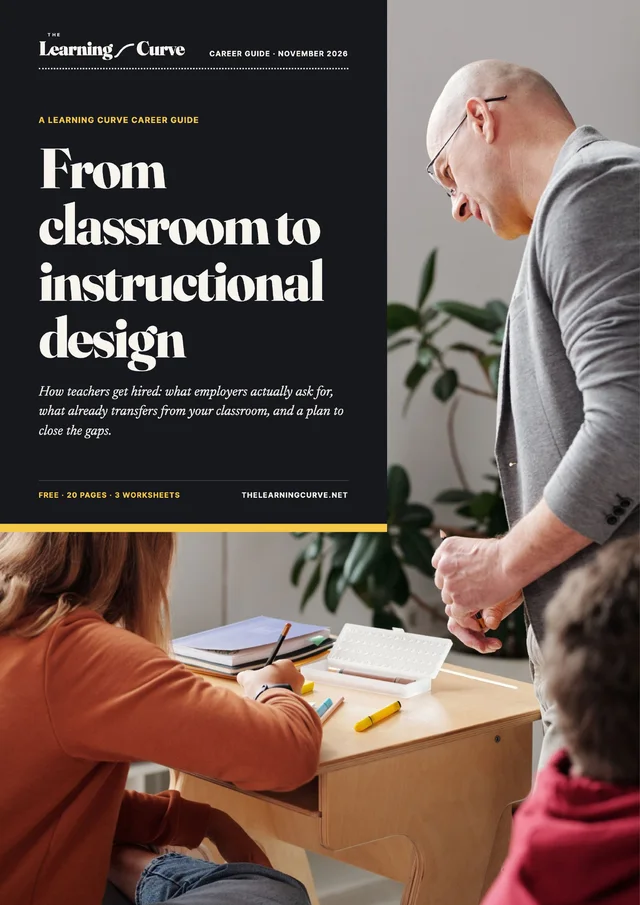
From classroom to instructional design
You already do most of the work. Employers can't see it yet. Here's what they actually ask for, what already transfers from your classroom, and a plan to close the gaps.
- What 1,030 job ads ask for, and where the jobs really are
- Your teaching, in their language: a translation table and CV rewrites
- The four gaps that stop teachers getting hired, and a six-step plan to close them
- Three printable worksheets to turn reading into a plan
- Built on published research
- Every source listed
- No course to sell you
- Honest about the limits
What employers actually ask for
The job ads are kinder to teachers than you might expect.
One study read 1,030 US instructional design job ads and coded every skill they named. A newer study of 130 ads shows where the jobs are. Here's what they found.
named face-to-face teaching. The ads want what teachers do, not teaching itself
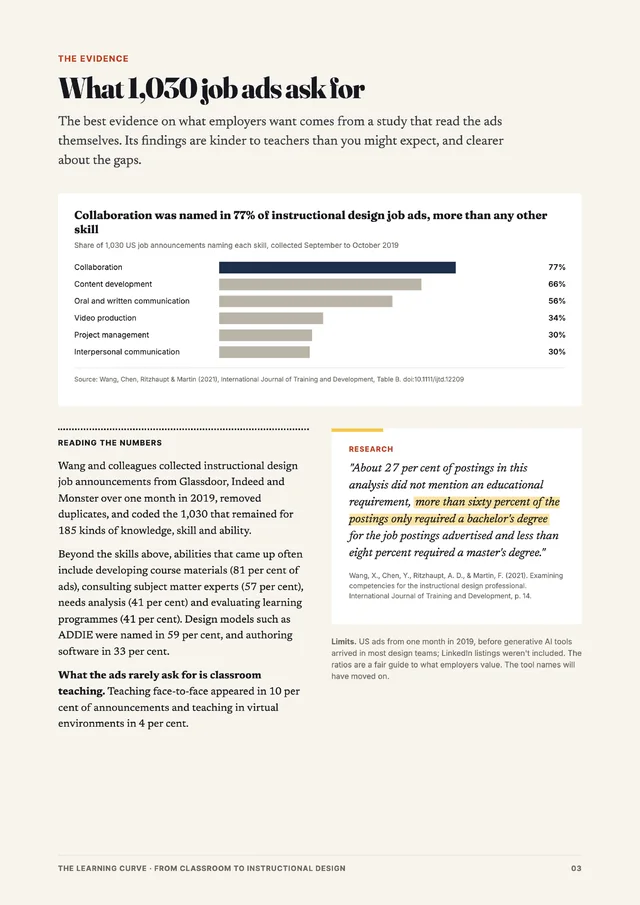
Collaboration was named in 77% of instructional design job ads, more than any other skill
Share of 1,030 US instructional design job announcements naming each skill, collected September to October 2019
Interactive chart. The figures are in the table below.
Show the data
| Job ads naming the skill | |
|---|---|
| Collaboration | 77.18% |
| Content development | 65.92% |
| Oral and written communication | 56.41% |
| Video production | 33.88% |
| Project management | 30.29% |
| Interpersonal communication | 29.51% |
Say it in their language
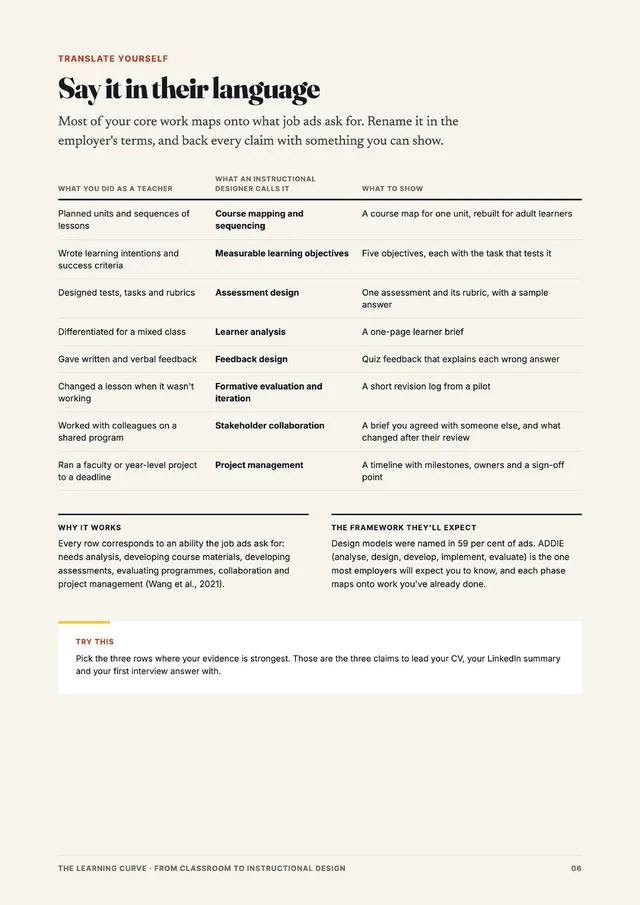
A hiring manager may not recognise “unit planning” as course design.
Most of your core work maps onto what job ads ask for. Tap a card to see what an instructional designer calls it, and what to show as evidence.
From the translation table on page 6. Every row corresponds to an ability the job ads ask for (Wang et al., 2021). The guide also rewrites a teaching CV, line by line, as a design CV.
The four gaps that stop teachers getting hired
They're rarely about learning.
The guide is honest about the distance. These are the gaps hiring managers notice, and each one has a step in the plan.
- 01Working through someone else's expertise
A subject matter expert owns the content and someone else runs the course. Consulting experts was named in 57 per cent of job ads.
- 02Projects with deadlines, budgets and sign-off
Project management appeared in 30 per cent of ads. A school term has a rhythm; a design project has stakeholders who change their minds.
- 03Authoring and media tools
Authoring software appeared in roughly a third of ads. You don't need all of them. You need one well enough to build a sample.
- 04Explaining your decisions
Teachers make good design decisions by instinct. Designers are asked to defend them to people who don't share that instinct.
The evidence, the translation table, the plan and three worksheets. Free.
Get the free guideSix steps from classroom to first design role
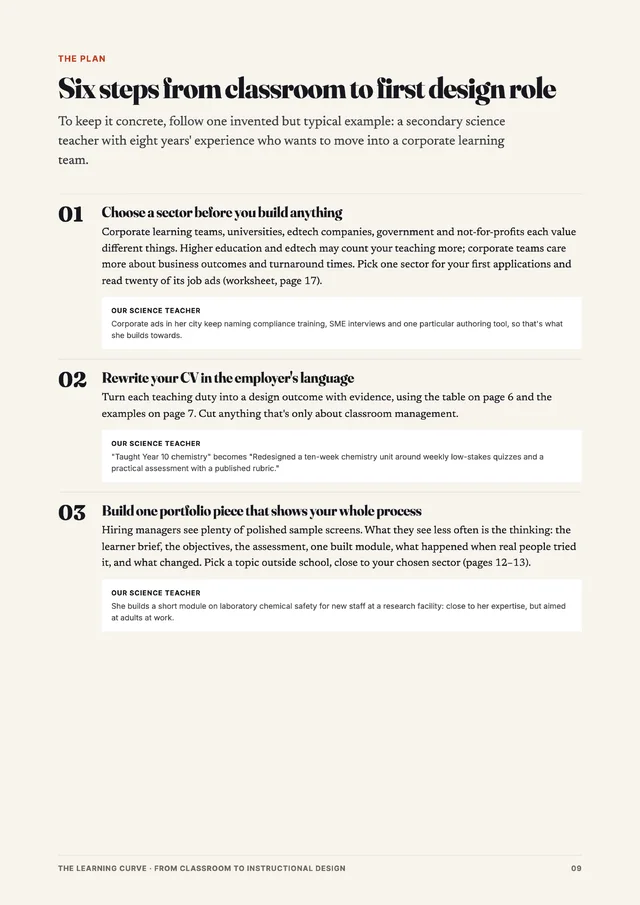
Follow one secondary science teacher through the plan.
An invented but typical example: eight years in the classroom, aiming for a corporate learning team.
- 01 Choose a sector before you build anythingOur science teacherCorporate ads in her city keep naming compliance training, SME interviews and one authoring tool, so that is what she builds towards.
- 02 Rewrite your CV in the employer's languageOur science teacher"Taught Year 10 chemistry" becomes "Redesigned a ten-week chemistry unit around weekly low-stakes quizzes and a practical assessment with a published rubric."
- 03 Build one portfolio piece that shows your whole processOur science teacherA short module on laboratory chemical safety for new staff at a research facility: close to her expertise, but aimed at adults at work.
- 04 Learn one authoring tool well enough to build your sampleOur science teacherThe one that recurs in the twenty ads she read, learned by building her portfolio piece in it.
- 05 Get real experience working with a subject expertOur science teacherA small project where someone else owns the content, run with a brief, a review round and sign-off.
- 06 Apply where your background counts mostOur science teacherEducation-focused companies, university learning design teams and training roles close to her subject.
Hiring managers look at portfolios
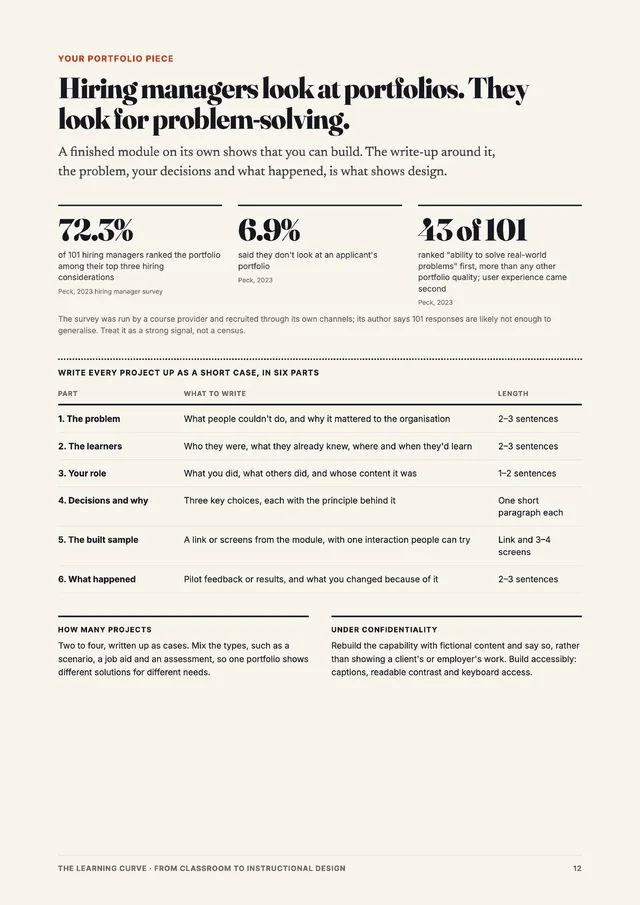
From page 12
They look for problem-solving, not polish.
72.3% of 101 hiring managers ranked the portfolio among their top three hiring considerations.
43 of 101 ranked “ability to solve real-world problems” first, ahead of any other portfolio quality.
Source: Peck, 2023, a survey run by a course provider. Its author says 101 responses are likely not enough to generalise; treat it as a strong signal, not a census.- The six-part case write-up hiring managers want to see
- How many projects, and what to do under confidentiality
- The one move that matters most: a design rationale for every major choice
Three worksheets, built to print
- Worksheet 1
Your portfolio project brief
Fill it in before you build anything.
- Worksheet 2
The twenty-ad audit
Tally what employers in your sector actually ask for.
- Worksheet 3
Translate your own experience
Six things you designed, renamed and evidenced.
Two of the five mistakes that slow the switch
Leading with years of teaching. Employers read "twelve years in the classroom" as delivery experience. Lead with what you designed.
Building a portfolio of school lessons. A Year 7 lesson reminds hiring managers of the gap. Build for adults at work, even if the topic is close to your subject.
Get the career guide
What employers ask for, what already transfers, the four gaps, a six-step plan, what the job pays and three worksheets. 20 pages, free.
Questions teachers ask
Who is the guide for?
Primary, secondary, tertiary and vocational teachers thinking about moving into instructional design, whether you are still teaching and exploring, applying now, or have recently left the classroom.
Do I need a master’s degree to become an instructional designer?
Usually not. In an analysis of 1,030 US instructional design job ads, more than 60 per cent asked only for a bachelor’s degree and fewer than 8 per cent asked for a master’s (Wang et al., 2021). The guide explains where a master’s is more often expected.
Is it really free?
Yes. The guide is a free PDF. You’ll also get The Learning Curve’s monthly newsletter, which you can leave at any time. We don’t sell courses or certificates in the guide.
Does it cover Australia?
Yes, where the evidence allows. The job-ad studies are from the US, and the guide says so. It covers Australian and New Zealand job titles, and flags that reliable Australian pay data is still being researched.
About this guide
Written by The Learning Curve and checked in November 2026. Figures come from Wang, Chen, Ritzhaupt and Martin (2021), Weber, McCarthy, Campbell and Bauer (2024), the US Bureau of Labor Statistics and the Peck (2023) surveys; the job-ad studies are of US ads and apply to those samples. Every source is listed in the guide.
Want the long read first? Instructional design jobs for former teachers · Portfolio examples · How we're funded