01Template
Learning objectives builder
Turn a vague goal into objectives a learner can meet and you can assess, with verbs matched to the level of thinking you want.
Built on: writing learning objectives, Bloom’s taxonomy
Free toolkit · For people who build courses
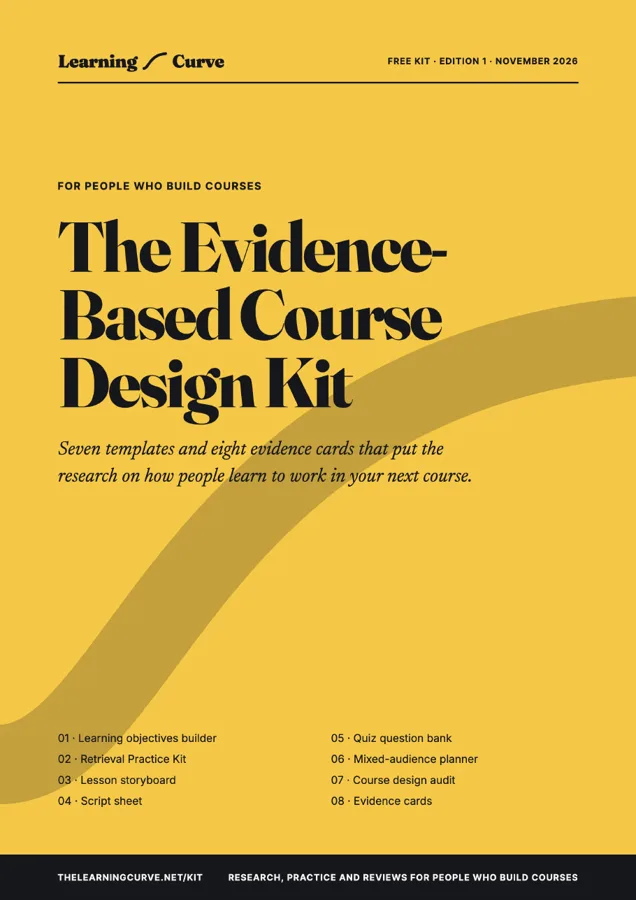
Seven templates and a set of evidence cards that turn the research on how people learn into tools you can use right away. Plan the objectives, storyboard the lessons, write the quizzes and audit the course, with the studies built in.
One kit for the whole build, from the first objective to the final audit.
Turn a vague goal into objectives a learner can meet and you can assess, with verbs matched to the level of thinking you want.
Built on: writing learning objectives, Bloom’s taxonomy
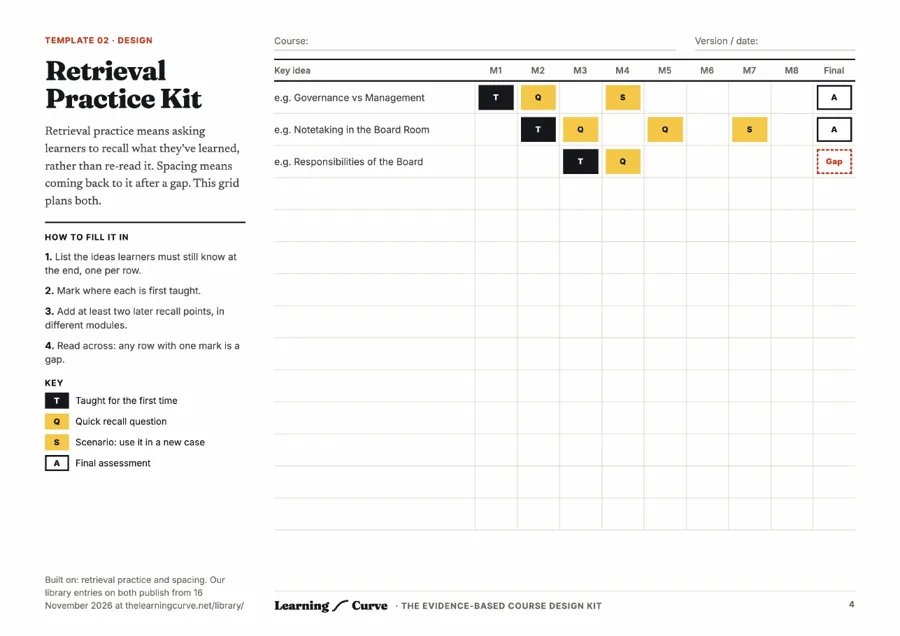
Plan where every key idea gets recalled again, so nothing important is tested once and forgotten.
Built on: retrieval practice and spacing
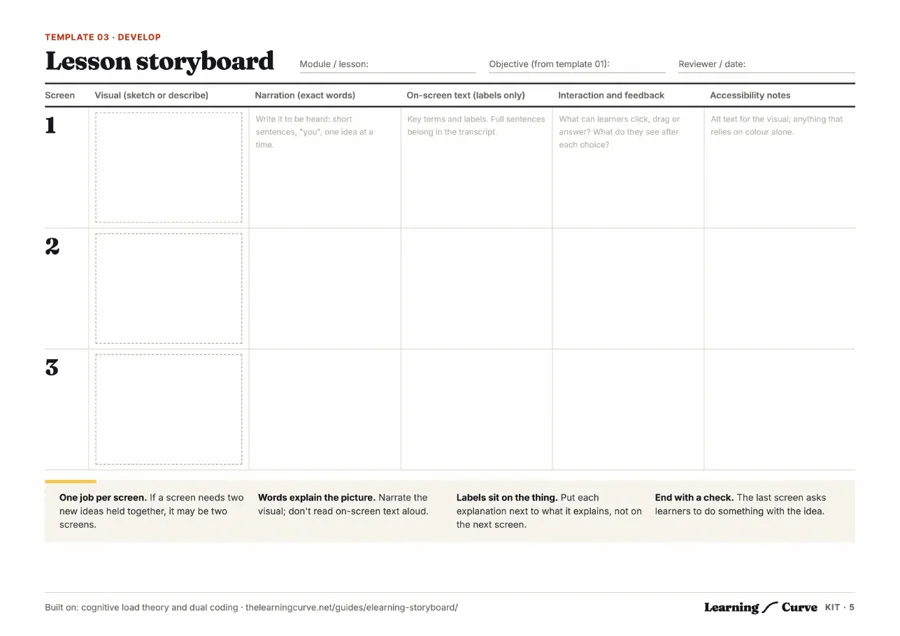
Sketch each lesson screen by screen: the objective, what’s shown, what’s said, and the check at the end.
Built on: cognitive load, dual coding
Write narration that sounds like a person talking, timed against what’s on screen.
Built on: dual coding, the redundancy effect
Write multiple-choice questions with plausible distractors and feedback that teaches, one row per question.
Built on: effective feedback, formative assessment
Decide where beginners get worked examples and where experienced learners can skip ahead.
Built on: the expertise reversal effect
Score a course you’ve already built against 24 evidence-based checks, and see where to fix first.
Built on: the whole research library
One printable page per principle: what it is, how strong the evidence is, and what to do on Monday.
Built on: our library entries and the studies they cite
A look inside · Template 02
List the ideas that matter in each module, then plan where learners will be asked to recall each one again: a quick quiz two modules later, a scenario question at the end. The grid makes it obvious which ideas you only ever test once.
As a Google Sheet, it colours itself as you fill it in.
| Key idea | M1 | M2 | M3 | M4 | Final |
|---|---|---|---|---|---|
| Chart of accounts | Teach | Quiz | Case | Test | |
| Bank reconciliation | Teach | Quiz | Test | ||
| GST on sales | Teach | Quiz | Gap |
Each template puts one or more findings from our research library to work, and links to the entry that explains the studies, how strong the evidence is and where it stops.
Make a copy of each Google Doc or Sheet and start filling it in, or print the PDF and work on paper. No sign-up to another tool, no special software.
As new library entries and guides publish, we add templates and evidence cards. Everyone who has the kit gets the new pages by email.
Anyone who builds courses and wants them to work.
The Learning Curve is an independent publication on how to design online courses that work. It's edited by Jim Lounsbury, who works in educational development at Avondale University, designing course content and microcredentials.
“I put this kit together because I think we can do a better job of designing courses around how people actually learn, rather than simply following convention or relying on what we've always done.”
Yes. You give us your name and email, and we send the kit. You’ll also get our monthly newsletter, which you can leave with one click.
Each one is a Google Doc or Sheet you copy into your own Drive, and the whole kit also comes as one printable PDF. Copies open in Word and Excel too.
No. Each template explains what it’s built on in a line or two and links to the library entry if you want the detail.
Yes. The kit is for planning and writing, so it works whatever you build in: an LMS, a course platform or an authoring tool.
Free · Seven templates · Eight evidence cards