Curiosity Corner · Ripped from the research
What happens when we forget?
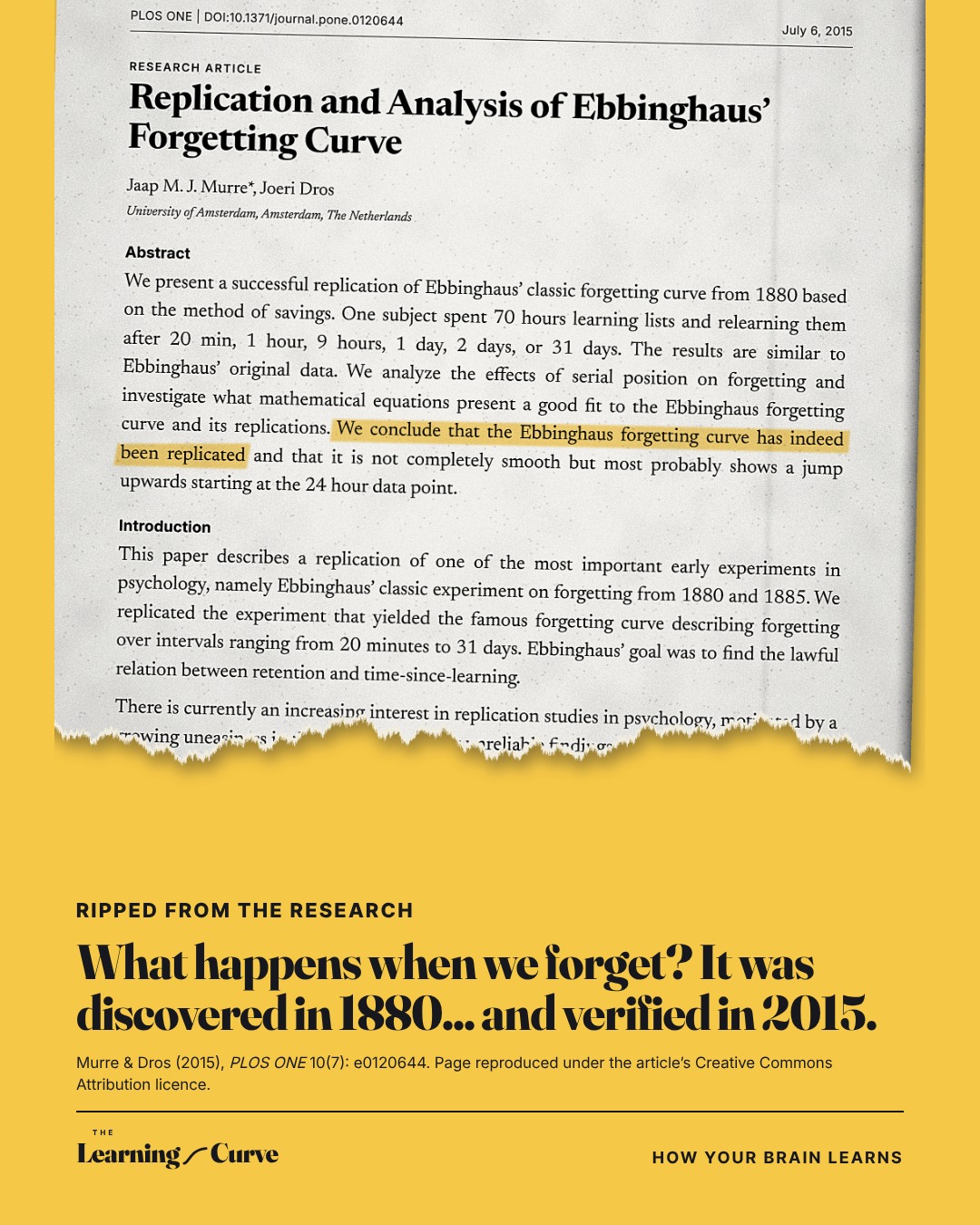
In 1880, Hermann Ebbinghaus set out to measure forgetting. He learned lists of nonsense syllables, then timed how long it took to relearn them after intervals from 20 minutes to 31 days. The result was the forgetting curve: memory fades fast at first, then more slowly.
In 2015, Jaap Murre and Joeri Dros at the University of Amsterdam repeated the experiment. One person spent 70 hours learning and relearning lists, and the curve came out much like Ebbinghaus's original.
Their one surprise: the curve isn't perfectly smooth. In the authors' words, it most probably shows a jump upwards starting at the 24-hour data point.